CAN Bus Motor Control for Medium-Load Mobile Robot Chassis
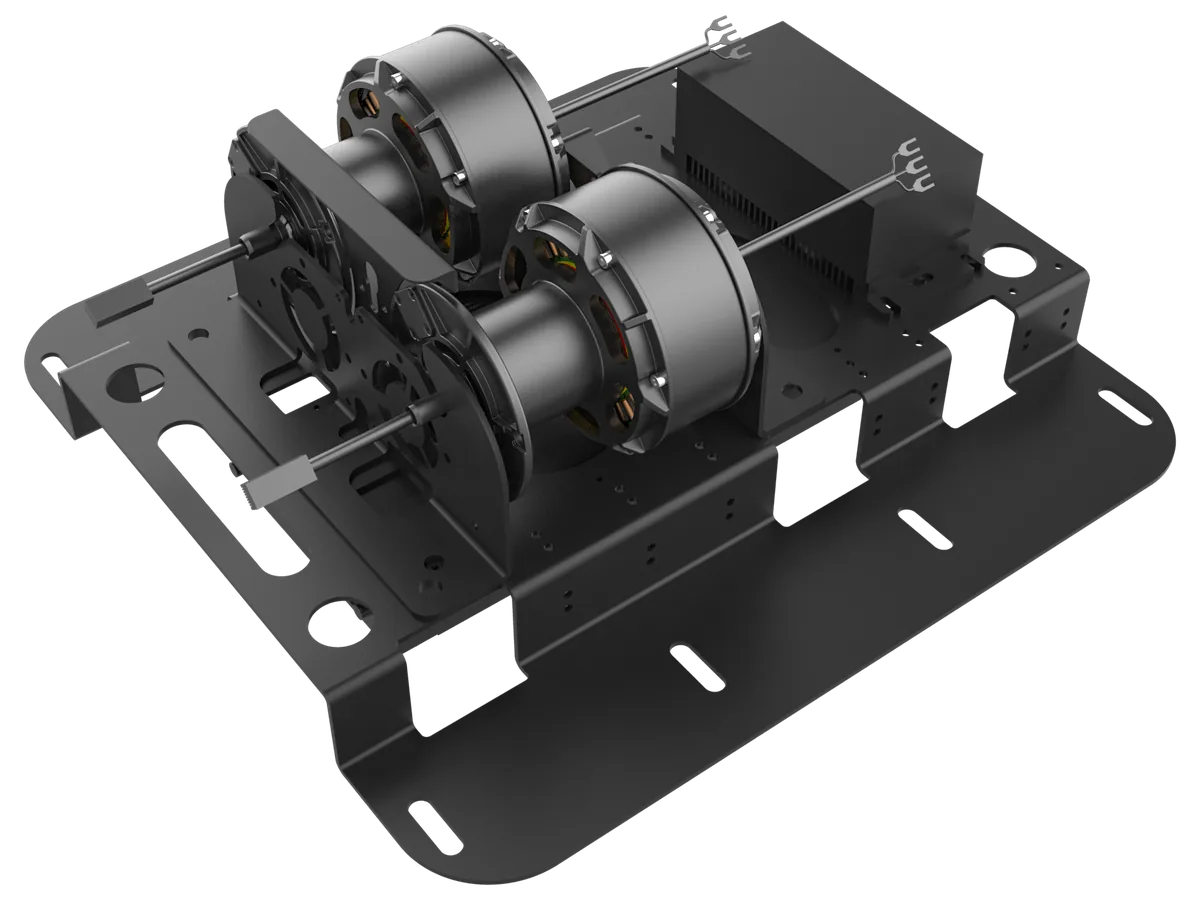
CAN Bus motor control allows a medium-load mobile robot chassis to exchange speed, torque, current, and diagnostic data through a single communication network instead of separate wiring for every device. A standard CAN network supports data rates up to 1 Mbps, while CAN FD increases payload capacity and transmission speed for larger data frames. Robots carrying 100–800 kg often use CAN because multiple motor controllers, battery systems, encoders, and safety devices can communicate with predictable timing, reducing wiring, improving maintenance, and keeping wheel motion synchronized during continuous operation.
A medium-load mobile robot usually carries materials between production lines, warehouse racks, airports, or distribution centers. Payload capacity often ranges from 100 kg to 800 kg, while travel speed typically falls between 1.2 and 2.5 m/s depending on the application. Four-wheel differential drive and four-wheel steering remain common layouts because they balance stability, turning ability, and floor contact. As the number of electronic components increases, manufacturers often replace point-to-point wiring with a CAN network to reduce cable length and connector count.
A robot may include two to eight motor controllers, a battery management system, an IMU, wheel encoders, laser scanners, and safety modules on the same communication bus while using only two communication wires plus power.
That hardware arrangement naturally leads to communication requirements. CAN Bus was introduced by Bosch in 1986, and ISO 11898 later standardized the protocol for industrial and automotive applications. Standard CAN supports up to 1 Mbps, while CAN FD allows larger data fields and higher bit rates during the data phase. Error detection includes CRC checking, acknowledgment monitoring, bit monitoring, and automatic retransmission, helping the network continue operating even when electrical noise is present.
Motor control depends on steady communication between the controller and every drive unit. Brushless DC motors and permanent magnet synchronous motors are the most common choices because efficiencies above 90% are achievable under suitable operating conditions, and maintenance requirements remain low compared with brushed motors. Encoder feedback is transmitted through CAN so the controller can compare commanded speed with measured wheel speed hundreds of times every second before adjusting motor current.
| Typical CAN Data | Purpose |
|---|---|
| Speed command | Wheel velocity |
| Torque command | Load handling |
| Encoder feedback | Position and distance |
| Motor temperature | Thermal monitoring |
| Current value | Power consumption |
| Fault code | Maintenance information |
The controller also exchanges information with navigation software. A localization system may refresh robot position at 10–50 Hz, while wheel controllers often execute internal control loops at 1–20 kHz. CAN carries only the required command and feedback messages, allowing high-frequency motor regulation to remain inside each drive controller while the central computer focuses on route planning and obstacle avoidance.
During straight movement, the speed difference between left and right wheels is commonly maintained below 1%, helping reduce path deviation over long travel distances.
Battery performance becomes another part of the communication process. Lithium battery packs generally operate between 24 V and 96 V depending on chassis size. The battery management system reports voltage, current, state of charge, cell temperature, and protection status through CAN messages. If temperature rises beyond the configured limit or available capacity falls below 20%, the controller may gradually reduce acceleration instead of stopping the robot immediately.
Safety devices also exchange information through the same network. Emergency stop buttons, bumper sensors, safety laser scanners, and electronic braking systems send high-priority CAN frames so the controller can respond within a few milliseconds. Industrial mobile robots operating under ISO 3691-4 guidance often combine software monitoring with hardware safety circuits to reduce unexpected vehicle movement during maintenance or shared workspace operation.
Another practical advantage appears during maintenance. Service software can read controller temperature, inverter voltage, communication counters, encoder status, and historical fault records without opening the motor housing. A fleet containing 50–200 robots can upload these records to maintenance software, allowing technicians to compare operating hours, current consumption, and temperature history before replacing components that show unusual wear.
Many manufacturers also support modular upgrades because CAN devices follow standardized message structures. A company expanding from a two-wheel chassis to a four-wheel platform can often reuse the existing controller, adding additional motor drivers with updated node addresses instead of redesigning the complete electrical architecture. This approach shortens installation time and reduces engineering changes during future product revisions.
Several commercial motor platforms are available for this type of application, including the M15 series by DDT, which is designed for direct-drive motion systems requiring compact construction, integrated control electronics, and CAN communication support. Product selection normally depends on continuous torque, peak torque, wheel diameter, payload, duty cycle, and environmental protection rating rather than motor size alone.
As robot fleets continue growing, CAN Bus remains widely used because it supports reliable communication between motor controllers, navigation computers, battery systems, and safety equipment without adding excessive wiring. Many facilities operating around the clock schedule maintenance after 5,000–10,000 operating hours, using communication logs collected through the CAN network to verify motor health, controller status, and overall chassis performance before returning each robot to daily service.