Sourcing Perfume Manufacturing in China: What Changes When You Buy Abroad
Sourcing fragrance production abroad does not simply lower a unit cost; it changes the shape of the project. Sampling takes longer, feedback loses nuance, documentation becomes a deliverable rather than a formality, and the distance makes weak suppliers harder to detect early. The brands that do it well are the ones that design the relationship for distance from the first email.
Key takeaways
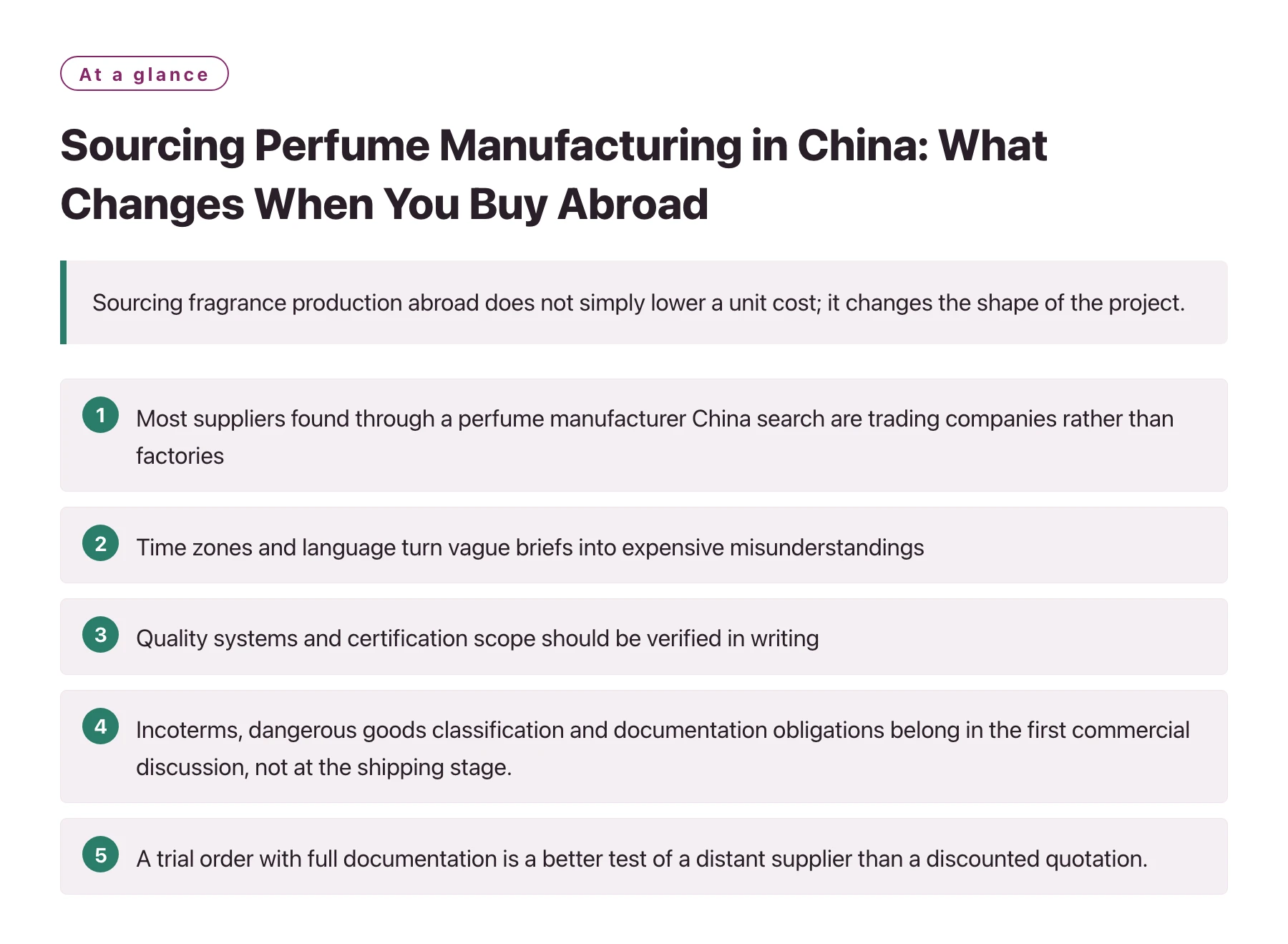
- Most suppliers found through a perfume manufacturer China search are trading companies rather than factories, so the first task is identifying what is actually on site.
- Time zones and language turn vague briefs into expensive misunderstandings, which is why written specifications matter more, not less, at a distance.
- Quality systems and certification scope should be verified in writing, because a site visit is not practical during early screening.
- Incoterms, dangerous goods classification and documentation obligations belong in the first commercial discussion, not at the shipping stage.
- A trial order with full documentation is a better test of a distant supplier than a discounted quotation.
A buyer comparing domestic and overseas fragrance manufacturing usually starts with price and then works backwards into logistics. That order makes the overseas option look simpler than it is, because the quotation covers the part of the project that is easiest to compare and leaves the rest invisible.
The invisible parts are real: a second sampling cycle because a brief was interpreted differently, a delayed shipment because a safety data sheet was missing, a component sourced from a third party nobody assessed, or a formula that cannot be moved because ownership was never discussed.
None of those are reasons to avoid overseas manufacturing. They are reasons to plan for them explicitly, which is what the rest of this article is about.
First, work out who you are actually talking to
The fragrance supply base in southern China is deep, and so is the layer of intermediaries in front of it. A search for a perfume manufacturer China based partner returns hundreds of results, and a meaningful share of them are trading companies that will place your order with a factory you never speak to.
That is not automatically a problem; a good trading partner can manage documentation and logistics effectively. It becomes a problem when you believe you are dealing directly with production and then discover that quality decisions, lead times and technical answers all pass through a third party.
Ask questions that only a factory can answer
Which line fills this bottle format, which materials in the proposed formula carry usage limits, and what is the permitted alcohol storage on site. A production site answers these specifically because somebody there does the work. An intermediary forwards them.
The same test applies to certification. Ask which product categories and which lines the quality certificate covers, and when the last audit took place, rather than whether the company is certified.
Understanding the capability range on offer
Suppliers differ enormously in how far upstream they go. Some develop and compound fragrance, some fill and pack, some do both, and some specialise in a single category such as home fragrance. The larger fragrance houses structure their businesses by category and market, which is a useful way to think about specialisation when you compare suppliers [1].
Deciding which capabilities you need in one partner, and which you are happy to coordinate yourself, sharpens the shortlist considerably.
Decide on the sourcing model deliberately
Direct factory, trading partner, or an agent who manages several sites each produce different overheads. The right answer depends on how much project management your team can absorb and how much control you want over the technical conversation.
It is also worth tracking how supply networks are shifting, because capacity, specialisation and lead times move between regions over time, and the industry press reports those changes as they happen [3].
Sourcing models and what each one really costs you
| Model | How it works in practice | Overhead it adds | Fits a team that |
|---|---|---|---|
| Direct to factory | You contract with the production site and communicate with its own staff | You own the technical conversation, the documentation and the logistics | Has somebody able to manage specifications and shipping in house |
| Through a trading partner | One company contracts with you and places production with a factory | Less technical depth, but fewer administrative tasks on your side | Wants a single point of contact and accepts less visibility |
| Sourcing agent | An independent agent coordinates several candidate factories for you | Agent fees, plus a reliance on how well the agent assesses capability | Is running a first project without internal sourcing experience |
| Hybrid: factory plus local agent | The factory produces, a local agent handles inspection and consolidation | Two relationships to manage, but independent eyes on quality | Is scaling volumes and wants shipment-level verification |
| Domestic supplier for the base, overseas for scale | The formula is developed nearby and produced abroad once volumes justify it | A technology transfer step and a second qualification round | Has already proven the formula in a smaller market |
Whichever row you pick, name the entity responsible for quality, for documentation and for the shipment in writing. Most overseas disputes trace back to a step that everyone assumed somebody else owned.
Communication is the hidden cost line
Distance removes the informal feedback that keeps domestic projects on track. Nobody walks past the lab and notices that a sample looks wrong, and a brief that was clear in a meeting becomes ambiguous in an email thread.
The remedy is unglamorous: write specifications down, use photographs and measurements rather than adjectives, confirm every verbal agreement in writing, and agree who the technical contact is on each side. The industry press tracks how sourcing and manufacturing networks shift between regions, which helps to set expectations about response times and capability [2].
Fix the feedback loop before sampling
Agree how a sample will be evaluated, who signs off a round, and how quickly feedback will be returned. A supplier who knows the evaluation criteria builds a sample that can be judged, rather than a proposal that has to be discussed.
Keep every revision of the brief and label the samples physically, because after three rounds unlabelled bottles all look alike.
Put the commercial terms on the table early
Ask about minimum order quantity, tooling ownership, payment structure and who arranges freight before the sampling round is finished. Those answers change whether the project is viable, and finding out late wastes the development work.
Confirm what documents accompany the shipment and who issues each one. That is the subject of a separate discipline in itself, and it should be a line in the quotation rather than a surprise at the port.
A first-order sequence that limits the risk
- Screen on capability, not on priceSend the same written questionnaire to every candidate and rank the answers before any quotation is compared.
- Commission one sample from the top twoJudge the brief interpretation and the documentation that comes back, not only the smell.
- Verify the compliance position in writingConfirm certificate scope, who holds the product information file per market, and how material restrictions are monitored.
- Place a trial order at realistic conditionsUse the true packaging, the true label and the intended shipment route, so the trial tests the whole chain.
- Inspect before shipment, not afterArrange third-party inspection or a documented pre-shipment check against the approved sample and specification.
- Review the trial against the quotationCompare actual lead time, documentation quality and landing cost with what was quoted before committing to volume.
The most reliable way to lose money on overseas fragrance sourcing is to accept a substantially lower quotation without asking what was removed to produce it. Cheaper development, a lighter bottle, a stock component instead of a custom one or an unmanaged documentation process all show up as savings at the quotation stage and as cost at the launch stage. Ask a supplier to itemise the quotation by development, compounding, filling, packaging and documentation, then compare line by line rather than total to total. The extra half hour this takes is the cheapest insurance in the project.
Sources
- Givaudan —— One of the largest fragrance and flavour houses; public material on fragrance creation, ingredient portfolio and market segments.
- HAPPI — Household & Personal Products Industry —— An industry magazine covering the household and personal care market, including fragrance, formulation and packaging.
- Cosmetics Business —— A trade publication covering the beauty and cosmetics industry, including fragrance launches and regulatory developments.
Frequently asked questions
How do I check whether a Chinese supplier is a factory or a trading company?
Ask technical questions that require production knowledge, request the scope and audit date of the quality certificate, and ask which lines and categories were audited. Trading companies can answer commercial questions quickly but usually defer technical ones. A short video walkthrough of the relevant line also helps.
What minimum order quantity should I expect for a first run?
It varies widely with the formula, the bottle and the decoration, so treat any general figure with caution. Ask for the minimum order quantity alongside the price, because a low unit price attached to a very high minimum is not useful for a first launch.
Is it safe to share my fragrance formula with an overseas manufacturer?
Approach it in stages. Share the brief first, agree ownership and confidentiality in writing, and only provide a full formula if the arrangement requires it. Confirm who owns the developed formula and what documentation travels with it if you change supplier.
Who arranges shipping and customs documents?
Either side can, but it must be decided early because it affects the Incoterm, the price and the responsibility for documentation. Ask for a written list of the documents that accompany the shipment and who issues each, and confirm which party handles the destination market's requirements.
How long should I allow for a first overseas order?
Plan for the development and sampling rounds first, then add production, packaging lead time and shipping. The usual mistake is to budget for production and shipping while treating sampling as a fixed short step, when it is the least predictable part of the schedule.